


Ol Chiki Script
Syllabus: GS1/Culture
Context
- President Droupadi Murmu inaugurated the centenary celebration of the Ol Chiki script in New Delhi, emphasising its importance in preserving Santhal heritage.
About
- Ol Chiki was developed in 1925 by Pandit Raghunath Murmu to provide a dedicated writing system for the Santhali language.
- It comprises 30 letters designed to capture Santhali phonetics with precision, allowing systematic documentation of its vocabulary and grammar.
- Santhali, a member of the Austroasiatic language family, is spoken across Jharkhand, Odisha, West Bengal, Assam, and Bihar.
- It was included in the Eighth Schedule of the Constitution in 2003.
Do you know?
- Before the creation of Ol Chiki, the language was written in scripts such as Roman, Bengali, Odia, and Devanagari.
Source:PIB
Bhu-Aadhaar
Syllabus: GS2/ Governance
Context
- The Government of Delhi has initiated the assignment of a 14-digit Unique Land Parcel Identification Number (ULPIN), popularly termed ‘Bhu-Aadhaar’, to every land parcel in the Capital.
What is ULPIN (Bhu-Aadhaar)?
- Unique Land Parcel Identification Number (ULPIN) is part of the Digital India Land Records Modernization Programme (DILRMP).
- It is a 14-digit identification number accorded to a land parcel based on the longitude and latitude coordinates of the land parcel and depends on detailed surveys and geo-referenced cadastral maps.
- The system integrates GIS mapping, drone surveys, and Ortho Rectified Images (ORI) for accuracy.
- It functions as a digital land identity, similar in concept to Aadhaar for individuals.
Significance
- The initiative aims to enhance transparency, curb fraudulent transactions, and modernise land records through geospatial technology.
- It complements the SVAMITVA Scheme, under which 48 villages in Delhi have already been covered.
Source: ET
CBDC-based Digital Food Coupon Pilot in Gujarat
Syllabus: GS2/ Governance
Context
- The Government of India has launched a Central Bank Digital Currency (CBDC)-based Digital Food Currency pilot in Gujarat in collaboration with the Reserve Bank of India (RBI).
About
- Under the CBDC framework, digital coupons generated through the RBI will be credited directly to beneficiaries as programmable digital currency (e₹).
- Beneficiaries can redeem their entitled quantity of foodgrains at Fair Price Shops (FPS) using CBDC coupon or voucher codes.
- The system will address challenges related to biometric authentication and e-POS operational issues while ensuring secure, traceable and real-time transactions.
Evolution of Digital Reforms in Food Security
- Key initiatives taken in the past include:
- End-to-end digitisation of ration cards and nationwide portability under the One Nation One Ration Card (ONORC) framework.
- Deployment of electronic Point of Sale (e-POS) devices for Aadhaar-enabled authentication and real-time transaction capture.
- Rightful Targeting Dashboard: A data-driven validation mechanism that audits, verifies, and sanitises PDS databases to improve targeting accuracy and ensure that benefits reach eligible households.
- Ann Chakra: A digital supply-chain optimisation tool that enhances route planning and logistics efficiency in food grain movement, reducing transportation costs and delays.
- Ann Sahayata: A strengthened grievance redressal platform that improves transparency, responsiveness, and citizen-centric service delivery within the PDS framework.
Source: PIB
Government Launches “PM RAHAT”
Syllabus: GS2/Governance
Context
- Prime Minister Modi has approved the launch of the PM RAHAT (Road Accident Victim Hospitalization and Assured Treatment) Scheme.
Features of the Scheme
- Every eligible road accident victim on any category of road will be entitled to cashless treatment up to one lakh 50 thousand per victim, for a period of seven days from the date of accident.
- Stabilization treatment will be provided for up to 24 hours in non-life-threatening cases and up to 48 hours in life-threatening cases, subject to police authentication on an integrated digital system.
- It is implemented through a technology-driven framework amalgamating the Electronic Detailed Accident Report (eDAR) platform of the Ministry of Road Transport and Highways with the Transaction Management System (TMS 2.0) of the National Health Authority.
- This integration enables seamless digital linkage from accident reporting to hospital admission, police authentication, treatment administration, claim processing, and final payment.
- Reimbursement to hospitals will be made through the Motor Vehicle Accident Fund (MVAF).
- Grievances of road accident victims will be addressed by a Grievance Redressal Officer nominated by the District Road Safety Committee.
Source: PIB
Japan’s ‘God’s Crossing’
Syllabus: GS3/ Environment
Context
- A centuries-old winter phenomenon known as “Miwatari” (God’s Crossing) at Lake Suwa has failed to appear for several consecutive years, signalling the growing impact of climate change in East Asia.
What is “Miwatari”?
- “Miwatari” refers to a natural ice ridge that forms when the entire surface of Lake Suwa freezes. It occurs after several days of temperatures below –10°C.
- Thermal expansion and contraction of the frozen surface creates cracks; newly formed ice shards push upward, forming a raised ridge.
- Traditionally, it is believed to mark the path of a deity crossing the lake to visit his consort.
Evidence of Climate Change
- Miwatari appeared almost every winter until the 1980s, but its frequency has sharply declined since then and it has not appeared at Lake Suwa since 2018.
- Morning winter temperatures increasingly fail to drop low enough for complete lake freezing.
Source: TH
Kamala Hydroelectric Project
Syllabus: GS3/Infrastructure /Environment
In News
- Recently, the expert panel of the Ministry of Environment, Forest and Climate Change of India has recommended clearance for Kamala hydroelectric project in Arunachal Pradesh, which will require felling 23.4 lakh trees.
Kamala Hydroelectric Project
- It is a multipurpose project with the twin objectives of power generation and flood moderation. It is proposed by the National Hydroelectric Power Corporation (NHPC) Limited.
- It is located on the Kamla river, a right-bank tributary of Subansiri which is Brahmaputra’s tributary.
Source :IE
Emergency Landing Facility
Syllabus: GS3/Defence; Infrastructure
Context
- Prime Minister Narendra Modi inaugurated a 4.2 kilometre Emergency Landing Facility on the Moran Bypass in Assam, the first such facility in Northeast India.
About
- An Emergency Landing Facility or ELF is a reinforced highway stretch designed to act as an alternative runway for the Indian Air Force.
- The concept of ELF emerged during the Cold War, when countries developed highway runways to reduce the vulnerability of fixed airbases. Nations such as Finland, Sweden, and Switzerland continue to use such dual-use infrastructure.
- Located about 300 kilometres from the Line of Actual Control, the Moran ELF provides critical backup during conflict situations and strengthens disaster response in remote regions.
- It can handle fighter aircraft up to 40 tonnes and transport aircraft up to 74 tonnes.
- With around 15 such facilities now operational, this strategic grid stretches from the deserts of Rajasthan to the expressways of Uttar Pradesh and now to the strategic borders of the Northeast.
Source: TOI
Cheer Pheasant
Syllabus:GS3/Environment
In News
- BirdLife International and the International Union for Conservation of Nature (IUCN) classified the cheer pheasant as Vulnerable, a reflection of its small and naturally fragmented populations.
Cheer Pheasant
- The cheer pheasant nests on the ground and shows strong natal philopatry, relying on early successional grasslands maintained by low-intensity traditional cutting and burning.
- “Cheer” denotes the bird’s association with Chir Pine forests, while “Pheasant” refers to its belonging to the game-bird family, which predominantly consists of ground-dwelling species.
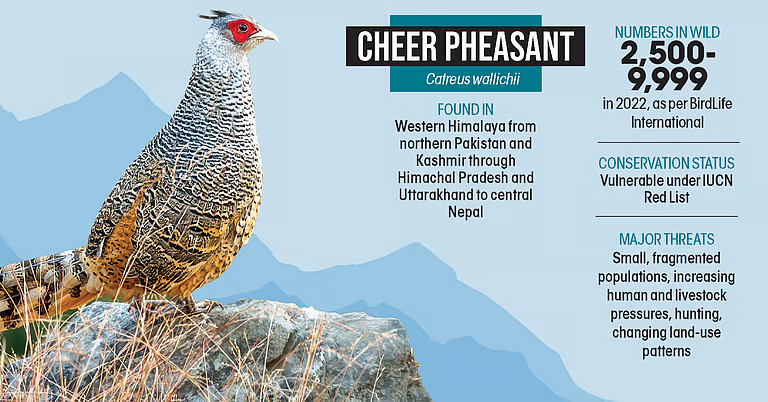
- The species now survives in scattered Himalayan grasslands across northern Pakistan, Kashmir, Himachal Pradesh, Uttarakhand, and central Nepal, preferring steep, rocky, scrubby slopes at 1,200–3,350 m elevation.
- The cheer pheasant enjoys the highest level of legal protection—Schedule I of India’s Wildlife (Protection) Act, 1972, and Appendix I of Convention on International Trade in Endangered Species of Wild Fauna and Flora (CITES)—and is safe-guarded across India, Nepal and Pakistan.
Source :DTE
Previous article
Calls For Reform of Global Trading System
